It was a very normal day, getting home from a day of gruelling classes and plopping down on my bed with my head swarming with ideas for my essay. Deciding to take a break by scrolling through tiktoks (quite counterproductive, yes), I came across one which told me “It has been proven that higher chocolate consumption is associated with Nobel prizes” Chocolate and nobel prizes? My two favourite things? So if I eat more chocolate, I will win a Nobel?! After my 2 seconds of excitement, I remembered from my logic class- correlation does not imply causation. While it is tempting to believe that chocolate increases the chance of receiving a nobel prize, more indirect relations can be observed. Chocolate can improve cognitive function, it is a luxury good so can be afforded by individuals who can also afford higher education or that it may just be institutional characteristics that influence Nobel prizes.
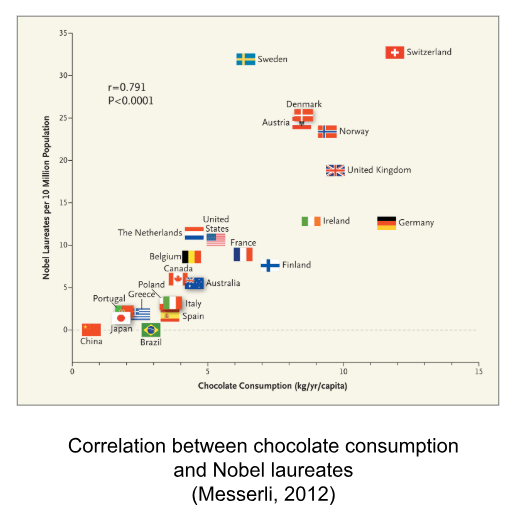
It is hypothesised that chocolate, by increasing cognitive function, increases the likelihood of receiving a Nobel. Messerli (2012) proposed that the increase in cognitive function is due to the presence of flavanols, a subclass of flavonoids, in chocolate, which is also supported by MD (2017). These flavanols have been linked to improved cognitive performance in Wistar-Unilever rats, improving endothelial function and slowing down reductions in cognitive performance caused by aging. The study observed a strong linear correlation (r=0.791, r=0.862 (excluding Sweden), p< 0.0001) between chocolate consumption per capita and number of Nobel laureates per 10 million people in 23 countries. An alternate hypothesis by Messerli (2012) was that people of superior cognitive function may be more aware of the health benefits of chocolate and thus consume more.
This study and hypotheses were challenged by another study Maurage et al. (2013), which pointed out methodological, statistical and logical issues. One key argument was that the correlation was based on country-averaged chocolate consumption and not on the consumption of Nobel laureates themselves. This caused an ecological fallacy where conclusions about individual behaviours are drawn from aggregate data (Ecological Fallacy, 2023). Furthermore, there is a temporal gap between data for chocolate consumption (measured for the last two years) and Nobel laureates (data from over a century). Another key argument was that flavonoids are also present in wine and tea, however, there was no such correlation between wine or tea and nobel laureates (wine: r=0.16, p=0.47; tea: r=0.03, p=0.88) in the same 23 countries. Thus, while there is a possibility that chocolate consumption may be related to Nobel laureates, cognitive function may not be the primary cause for the relationship.
It is also hypothesised that both high chocolate consumption and high number of Nobel laureates could have a common cause- high GDP. Ortega (2013) refuted Messerli’s study and instead proposed that a larger economy with higher incomes can afford chocolate because it is a normal good. However, they can also afford higher education which would possibly increase the likelihood of receiving a Nobel. Ortega (2013) observed a strong correlation of GDP with the number of Nobel laureates (r=0.71) and chocolate consumption (r=0.65). Nevertheless, due to the methodological limitation previously stated, this causal link may not be valid. As Grandjean (2015) noted, the data itself is variable, leaving space for contemplation, so the graph and conclusions drawn cannot be valid. While Maurage et al. (2013) also found a very similar strong correlation of GDP with chocolate consumption and Nobel laureates to Ortega, he noted that such an interpretational drift from correlation to directionality must never be allowed. This is because hidden factors influencing both variables separately cannot be excluded and so a third cause fallacy could always be involved.
A third hypothesis could be that chocolate is irrelevant for trends in Nobel prizes and institutional and cultural factors are more important causes. Strong educational traditions and the presence of research institutes could contribute to improvement in quality of physical capital in a country, inflow of talent from other countries and improved human capital, thus increasing the likelihood of receiving a Nobel prize. According to von Zedtwitz et al. (2024), Nobel prize discoveries are highly concentrated in just five countries and 30 % of Nobel laureates were immigrants. This supports the hypothesis that educational institutes play a major role in receiving Nobels.
It was an intriguing question whether eating chocolate could lead to getting a Nobel. The original paper by Messerli caused an uproar in the scientific community and quickly gained traction on various news and social media platforms. Although it was written as a parody, it highlighted the difficulties statisticians and researchers face. While this was a disappointing outcome for my chances at winning Nobel, it certainly affirms the merit of laureates like Joel Mokyr.
References
Dillow, C. (2012, October 12). The More Chocolate A Nation Eats, The More Nobel Prizes It Gets. Popular Science. https://www.popsci.com/science/article/2012-10/nations-chocolate-intake-directly-correlated-number-nobel-laureates-it-spawns-not-really/
Ecological fallacy. (2023). Europa.eu. https://data.europa.eu/apps/data-visualisation-guide/ecological-fallacy
Grandjean, M. (2015). About Nobel laureates and chocolate, correlations and unreliable data | Martin Grandjean. Martingrandjean.ch. https://www.martingrandjean.ch/nobel-chocolate-correlation/
Maurage, P., Heeren, A., & Pesenti, M. (2013). Does Chocolate Consumption Really Boost Nobel Award Chances? The Peril of Over-Interpreting Correlations in Health Studies. The Journal of Nutrition, 143(6), 931–933. https://doi.org/10.3945/jn.113.174813
MD, R. H. S. (2017, August 16). Your brain on chocolate. Harvard Health Blog. https://www.health.harvard.edu/blog/your-brain-on-chocolate-2017081612179
Messerli, F. H. (2012). Chocolate Consumption, Cognitive Function, and Nobel Laureates. New England Journal of Medicine, 367(16), 1562–1564. https://doi.org/10.1056/nejmon1211064
Ortega, F. B. (2013). The intriguing association among chocolate consumption, country’s economy and Nobel Laureates. Clinical Nutrition, 32(5), 874–875. https://doi.org/10.1016/j.clnu.2013.05.011
von Zedtwitz, M., Gutmann, T., & Engelmann, P. (2024). The Nobel “Pride” Phenomenon: An analysis of Nobel Prize discoveries and their recognition. Research Policy, 54(1), 105150. https://doi.org/10.1016/j.respol.2024.105150
 Nehal's Home
Leave a comment